
How to Check Criminal History in Vanderbilt
The first question is whether the desired file is a village administrative record or a criminal justice record. The official Village of Vanderbilt site is the proper route for records the village itself creates. It is not a substitute police portal. No independent Vanderbilt Police Department was confirmed, so incident and arrest requests must follow the responding county or state agency.
- Identify whether an Otsego County deputy, an MSP trooper, or another agency handled the Vanderbilt event.
- Request the incident report from that agency, not from the village merely because the event occurred there.
- Check the newest Otsego County jail PDF when an arrest may have led to a booking.
- Use 87-A District Court for arraignment, bond, misdemeanor, warrant, and felony preliminary records, then 46th Circuit after felony bind-over.
- Use ICHAT for broader public Michigan history and fingerprint review for the subject's own fuller state record.
This Vanderbilt sequence avoids a common dead end. The Vanderbilt village clerk can answer government-record questions, but the clerk cannot supply a Sheriff or MSP case file that Vanderbilt never held.
Vanderbilt Village Criminal Record Boundaries
Vanderbilt is an incorporated village, not Otsego County's second city. Vanderbilt's 2020 Census population was 498, and Vanderbilt is the county's only incorporated municipality besides Gaylord. That small Vanderbilt scale supports a shared records system, but it does not remove the need to identify the legal custodian.
Vanderbilt council minutes, ordinances, notices, and other village-created administrative files belong with Vanderbilt government. A Vanderbilt deputy response narrative belongs with the Sheriff. An MSP report belongs with MSP. A Vanderbilt jail intake record belongs with Otsego County. A criminal docket belongs with the court. The place name can appear in all of these records, yet no one Vanderbilt office holds the full chain.
The village government gateway shows the correct municipal starting point.

The gateway is useful for Vanderbilt records while keeping Sheriff, MSP, jail, and court requests on their separate official routes.
The Vanderbilt Police Department
No official independent Vanderbilt Police Department was found. A Vanderbilt criminal record page must not invent a Vanderbilt police desk, phone number, report form, arrest blotter, fee, or mobile app. Vanderbilt law-enforcement material ordinarily begins with the Otsego County Sheriff or Michigan State Police, depending on who responded.
For a Vanderbilt Sheriff event, Records at 124 S. Court Avenue in Gaylord can locate agency incident files. The published contact is 989-732-3555 ext. 2785. For a Vanderbilt MSP event, use the state police records and FOIA channel. A person who does not know the responder should begin with the date, exact location, names, and any incident number, then ask the likely agency to confirm custody before filing a broad request.
This Vanderbilt absence is not a gap to fill with a nearby city department. Gaylord Police is a city agency and does not become Vanderbilt's police custodian merely because the courts and jail sit in Gaylord.
Vanderbilt Sheriff and MSP Records
The Vanderbilt response agency determines both the request form and the likely record. Sheriff Records stores Sheriff case files, including Vanderbilt incident and accident reports. MSP maintains its own reports and statewide FOIA process. A county booking record can later show which agency made the arrest, but booking at the county jail does not make the Sheriff the owner of an MSP incident report.
| Vanderbilt need | Official custodian | Useful detail |
|---|---|---|
| Deputy incident report | Otsego Sheriff Records | Incident number, date, location, names |
| Trooper incident report | Michigan State Police | Post or agency, date, place, report sought |
| Village administrative file | Vanderbilt village government | Board, date range, and exact record |
The Michigan State Police FOIA page is the official state route for releasable MSP records.
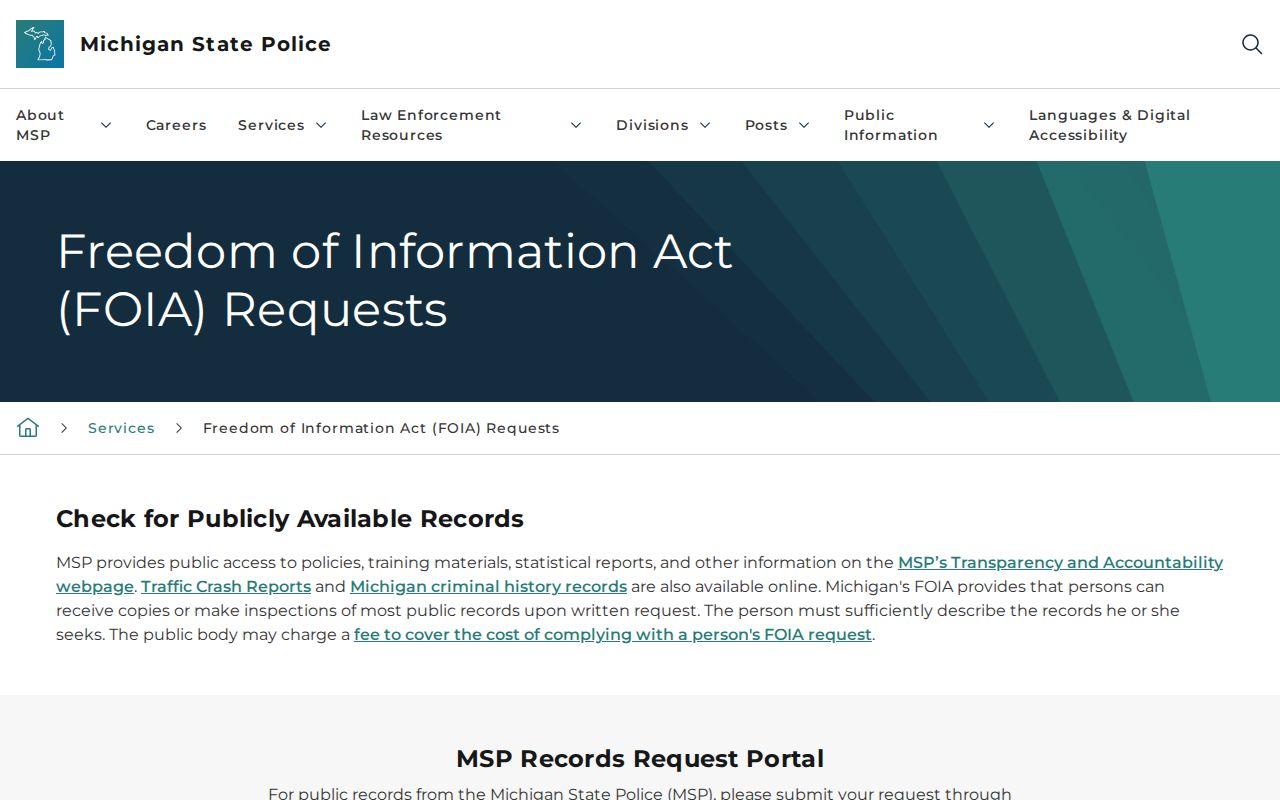
The state route should be used only when MSP holds the Vanderbilt report, preserving the line between state, county, and Vanderbilt village records.
Arrests and Bookings in Vanderbilt
Vanderbilt has no confirmed village jail. A person lodged after a Vanderbilt arrest goes into the Otsego County Jail record system at 124 S. Court Avenue in Gaylord. The Sheriff publishes a library of dated Vanderbilt PDF rosters and “Bookings With Charges” reports. It is not a live Vanderbilt search box and should not be treated as one.
The Vanderbilt PDF schema can show a booking number, date and time, release time when present, arresting agency, DOB, sex and race descriptors, housing classification, and charge rows. The sampled official report did not show mugshots, bond, next court date, magistrate, or warrant number. A Vanderbilt roster row documents processing into custody. It does not prove guilt or show every later change.
For immediate Vanderbilt status, read the latest printed cutoff and then call the jail at 989-732-3555. A fresh Vanderbilt arrest may be newer than the file, while an old file may remain available after release.
Vanderbilt Arrest Records After the Cutoff
If the newest roster predates the event, do not assume there was no Vanderbilt arrest. Call the jail, then check 87-A District Court for an arraignment or bond record. The court index may also lag a very recent incident, so the sequence matters. The responding agency remains the place for the police narrative.
If the person appears in an older Vanderbilt bookings PDF but not a current by-name roster, look for a release timestamp and ask the jail about present custody. A historical Vanderbilt entry can stay online as a record of the booking window. It is not a real-time detention flag.
Note: The printed time on an Otsego roster is the freshness limit for a Vanderbilt custody check, not a minor page detail.
Vanderbilt Municipal Court Records
Vanderbilt has no village criminal court in the official judicial inventory. Cases commonly described as “Vanderbilt court” use the 87-A District Court at 800 Livingston Boulevard, Suite 1-C, Gaylord. That court handles misdemeanors, arraignments, bail, warrants, and preliminary felony proceedings. A felony moves to the 46th Circuit Court at 225 W. Main Street after bind-over.
| Court Name | 87-A District Court, then 46th Circuit Court for a bound-over felony |
|---|---|
| Case Types Heard | Misdemeanors, arraignments, bond, warrants, felony preliminary stages, and Circuit felonies |
| Case Lookup Channel | MiCOURT Case Search when participating, plus the proper clerk counter |
| What the Docket Shows | Filed charges, events, hearings, orders, disposition, sentence, and public financial entries |
| Copies & Fees | Confirm with the clerk because no official Otsego copy or certification fee was found |
The Vanderbilt District Court route uses 989-731-0201. The Circuit Clerk phone is 989-731-7500. Selecting the real court name is essential because MiCOURT offers no Vanderbilt municipal-court choice.
Vanderbilt Criminal Cases Travel South
The local Vanderbilt record trip runs from Vanderbilt to Gaylord. Vanderbilt jail material sits at Court Avenue. District case material sits at the Alpine Center. Bound-over felony material sits at the downtown County Clerk. That geographic split is the defining access fact for a village resident.
- Arraignment
- The hearing where charges are stated and plea or bond issues are addressed in District Court.
- Bind-over
- The transfer of a felony from District Court to Circuit Court after waiver or a probable-cause finding.
- Register of actions
- The clerk's dated list of filings, hearings, orders, and outcomes for one case.
- Disposition
- The outcome of a charge, which must be read count by count.
A unified trial-court administration does not put all Vanderbilt files at one counter. Call the office tied to the Vanderbilt case stage rather than making a needless trip based on the broad phrase “county court.”
Where Vanderbilt Records End Up
A Vanderbilt incident starts with the responding agency, not village police. A lodged Vanderbilt person produces a county booking record. The 87-A District Court records early Vanderbilt hearings and misdemeanor outcomes. A Vanderbilt felony that is bound over produces a 46th Circuit file. Reportable fingerprints and dispositions then flow to the Michigan State Police Criminal Justice Information Center.
Record flow: Otsego Sheriff or MSP › Otsego County Jail › 87-A District Court › 46th Circuit Court › Michigan State Police CJIC
ICHAT is broader than one Vanderbilt incident search, but it remains limited. It omits warrants, local misdemeanors, traffic, juvenile and suppressed records, federal and tribal matters, and other states. It also does not contain the full Vanderbilt police narrative or every court filing. The Otsego County criminal court case records route gives more depth on the filed case.
Vanderbilt ICHAT Record Limits
ICHAT costs $10 per name search and returns the public subset of reportable Michigan history. It can add statewide context to a Vanderbilt inquiry, but it cannot show whether the Sheriff or MSP holds an uncharged incident report. A “no record” response means no public matching repository entry under the submitted identifiers, not that nothing happened locally.
For self-review, MSP provides a fingerprint-based personal record route that includes public and nonpublic Michigan information linked to the prints. It is the stronger basis for correcting a repository mismatch. Compare the returned arrest cycle and disposition against the convicting court before requesting a correction.
The MSP record review and correction instructions describe that official process.
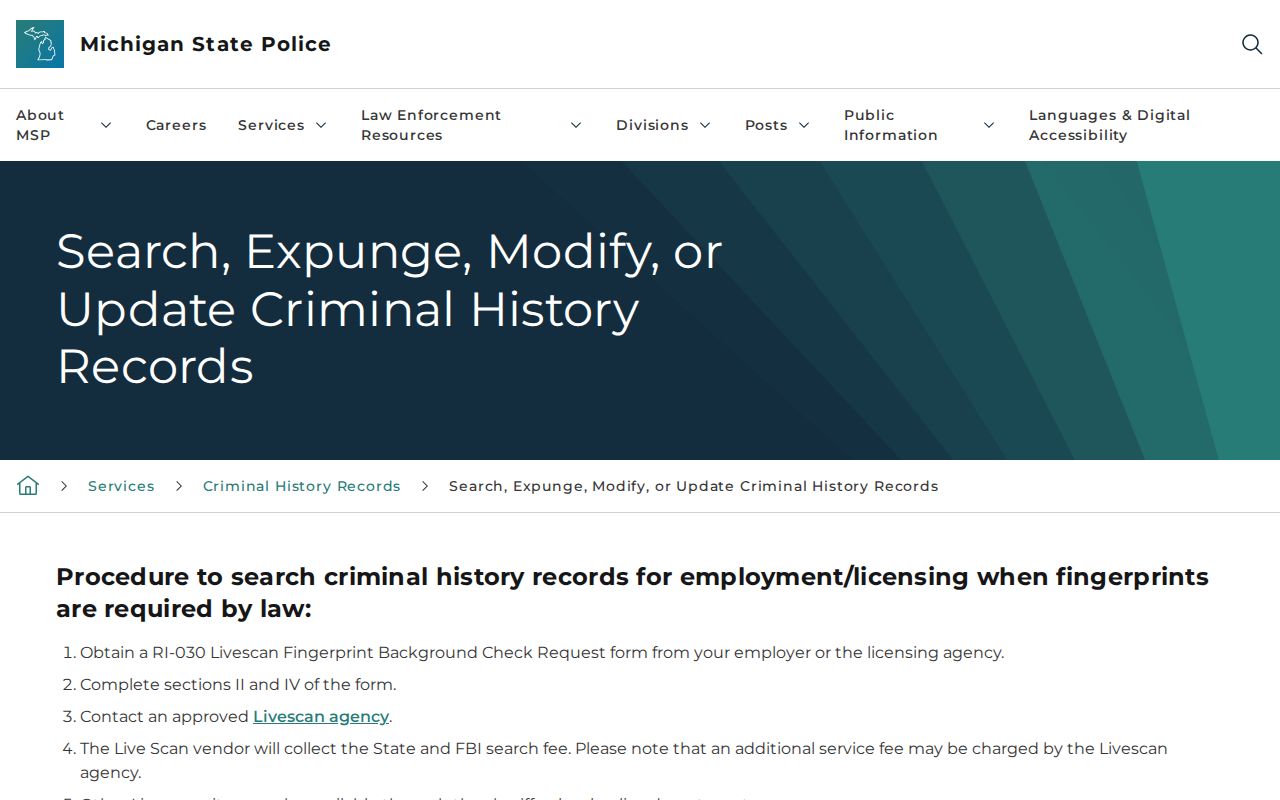
The Vanderbilt correction route is aimed at the state repository, while a Vanderbilt police-report error still belongs with the agency that created the report.
Vanderbilt Warrant Record Route
No official public Vanderbilt or Otsego name-search warrant portal was found. ICHAT expressly excludes warrants, and a jail roster shows a warrant-related charge only after a booking occurs. The correct path is the 87-A District Court for district warrants, 46th Circuit for felony or post-judgment matters, and the Sheriff or MSP for the originating law-enforcement record.
A person who believes a warrant may exist should call the issuing court or counsel for bond and appearance instructions. Do not rely on an old PDF or an unverified commercial result, and do not walk into an office based solely on a name match. Sealed warrants and juvenile matters may not be public.
This is one point where Vanderbilt's shared system is useful: the court name and Vanderbilt case stage narrow the call even though the village has no local court counter.
Vanderbilt Village and Police FOIA
Michigan FOIA governs releasable executive-agency and village records, but the request must reach the body that holds the file. A Vanderbilt administrative request goes to village government. A Sheriff police request goes to county Records. An MSP request goes to the state police. Court files use the clerk and Michigan Court Rule 8.119 instead of a village or Sheriff FOIA form.
The Vanderbilt request should name a clear date range, location, people or incident number, and the exact record sought. A public body may redact exempt content and charge costs allowed by law. Under MCL 15.235, the body generally must grant, deny, partly grant, or issue a permitted extension response within five business days.
The Legislature's Michigan FOIA access policy states the governing public-access principle.
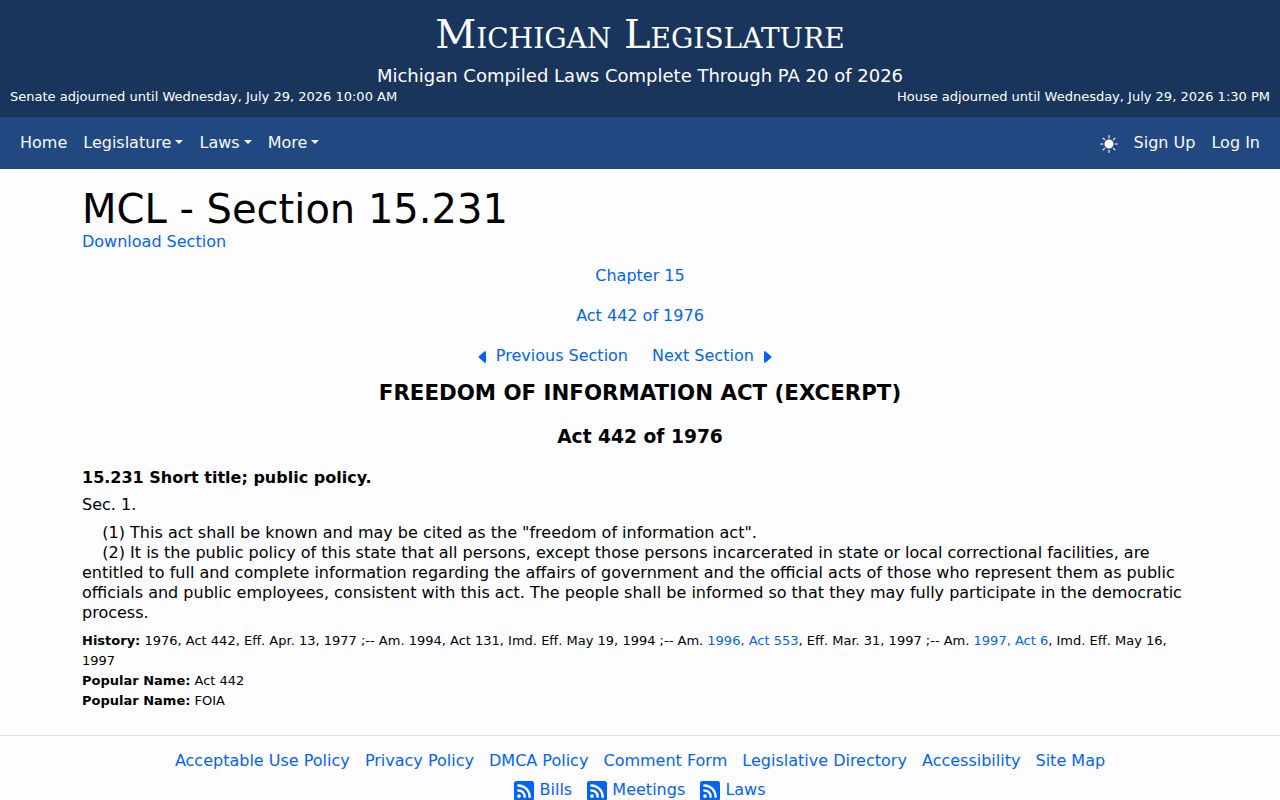
The law supplies a Vanderbilt access framework, but it does not turn village hall into the custodian of county or state police records.
Public Access Rules
Vanderbilt criminal records can contain public and restricted parts. Police may withhold active-investigation material and redact victim, juvenile, or protected personal details. Court files follow court access rules. Set-aside convictions, sealed records, and nonpublic juvenile matters do not belong in an ordinary public lookup.
Key Statutes:
Michigan FOIA, MCL 15.231 establishes the policy of access to public-body records, subject to legal exemptions.
MCL 15.235 sets the general five-business-day response framework and permitted extensions.
MCL 28.243 governs reporting and handling of criminal-history information in Michigan's repository system.
Always verify the person, agency, and final court disposition. A Vanderbilt arrest does not establish guilt, and the absence of a public ICHAT entry does not prove that no local incident or restricted record exists.